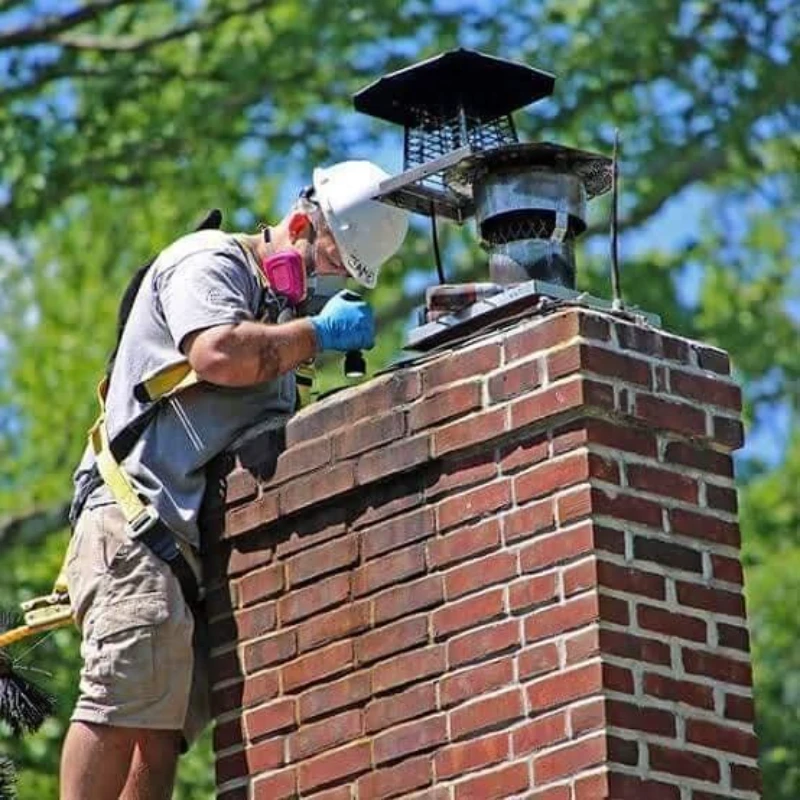
CSIA & NFI certified chimney service for Wade Hampton's established neighborhoods. Multi-fireplace homes with dual-flue chimneys are common here — we inspect and clean every flue, not just the one you know about.
Many of the larger traditional and split-level homes along the Wade Hampton corridor were built with two separate fireplaces — one in the main living area and one in a family room, study, or master bedroom — both vented through a single shared chimney structure with two separate flue tiles running side by side. Each flue is an independent pathway that must be inspected and cleaned on its own. During a standard service call we identify every flue present in the chimney, determine which are active and which have been sealed or converted, and assess and clean each active flue. Homeowners are sometimes unaware that a second flue exists until we document it.
The Wade Hampton area encompasses the residential neighborhoods north of downtown Greenville along the US-29 corridor — one of Greenville's most established residential zones, with a strong concentration of traditional brick homes built in the 1970s and 1980s on larger lots with mature landscaping.
Homes closest to Wade Hampton Boulevard itself include a mix of 1960s–1980s traditional brick designs — many with the distinctive double-chimney profile visible from the street. These larger homes were often built with gas utility connections but fitted with masonry wood-burning fireplaces as the primary hearth. In recent decades many have had gas log inserts installed in the original masonry firebox. These converted systems require inspection of both the original masonry flue and the gas appliance venting to confirm the installation was done correctly.
The western edge of the Wade Hampton corridor blends into the Northgate area, where 1970s ranch homes on large wooded lots are common. These properties tend to have single-flue masonry chimneys with original clay tile liners and cast iron throat dampers. The wooded setting creates additional chimney maintenance considerations — overhanging branches deposit debris into open chimney tops, and the heavy tree canopy can interfere with chimney draft on calm days by disrupting natural air pressure differentials above the crown.
Moving east toward Paris Mountain, properties become larger and more wooded with some acreage. Homes in this zone tend toward 1980s–1990s construction with a blend of masonry and factory-built wood-burning fireplace systems. The higher elevation relative to central Greenville also means slightly cooler average temperatures and more use of the fireplace as a supplemental heat source during shoulder-season months — which accelerates annual creosote accumulation.
The northeast end of the Wade Hampton area transitions toward Taylors — an overlap zone where 1970s–1980s traditional brick homes and early 1990s subdivisions intermix. Gas fireplace systems become more common in this newer construction zone. Many homeowners in the transition area use a wood-burning fireplace in the main living room alongside a gas fireplace or insert in a secondary room — requiring both CSIA masonry sweep expertise and NFI gas specialist knowledge on the same service call.
Wade Hampton's mix of multi-fireplace masonry systems and converted gas inserts means a technician needs both CSIA chimney sweep credentials and NFI gas specialist training. All our Wade Hampton service calls are staffed with both certifications available.
Annual sweep for single and dual-flue masonry chimneys. Each flue inspected and cleaned independently. For dual-flue systems we document both flue conditions and clearly communicate which fireplaces are connected to which flues — something larger homes often need clarified.
View serviceLevel 1 included with every sweep. Level 2 camera inspection recommended for Wade Hampton homes with clay tile liners showing age-related cracking, or any dual-flue chimney where one flue has been inactive for more than 3 years. Camera confirms liner integrity before the flue is returned to active use.
View serviceMany Wade Hampton masonry fireplaces now house gas log inserts. NFI-certified annual service covers burner cleaning, pilot and thermocouple inspection, log positioning, and verification that the original masonry flue is still suitable for gas appliance venting — a step often skipped during initial installation.
View serviceCrown resurfacing, tuckpointing, flashing repair, and damper replacement. Wade Hampton's larger chimneys often have wider chimney crowns that develop more significant cracking over time due to the greater expanse of poured mortar. Crown repair before water infiltration reaches the liner section is the most cost-effective intervention.
View serviceVapor-permeable waterproofing sealant applied to exposed brick and mortar joints. Particularly valuable for the taller, more exposed chimney structures common in Wade Hampton's two-story homes — greater surface area means more potential entry points for rainwater that causes internal deterioration.
View serviceProfessional dryer vent cleaning throughout the Wade Hampton area. Larger home floor plans with laundry rooms positioned far from exterior walls result in longer vent runs that accumulate lint at transition elbows. We clear the full run and test airflow at the exterior termination point.
View serviceCSIA & NFI certified chimney sweep for Wade Hampton's multi-fireplace homes and gas log inserts. We identify and service every flue — not just the one you know about.