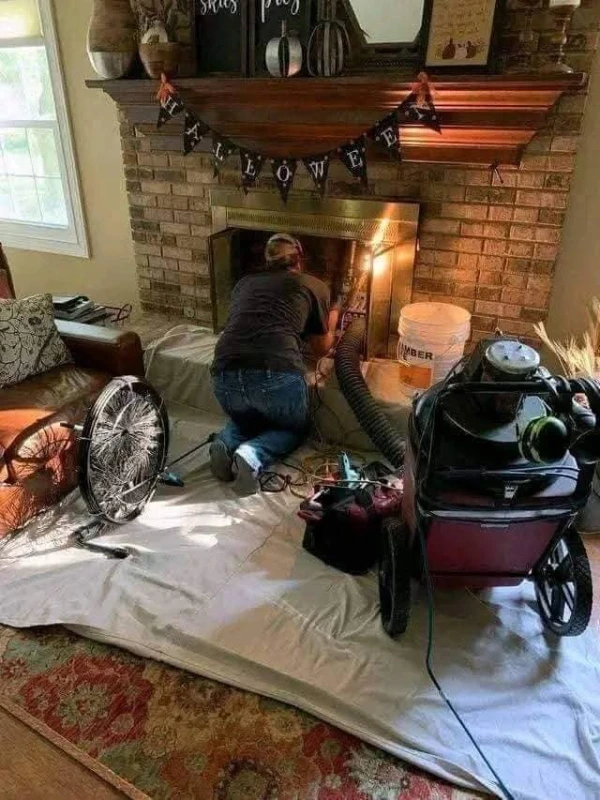
CSIA certified chimney sweep for Eastside Greenville's post-war brick homes. Original 1950s–1960s masonry fireplaces with 60+ year old clay tile liners need more than a standard annual sweep — they need a technician who understands what that age looks like inside a flue.
Eastside Greenville encompasses the residential neighborhoods east of downtown — a zone that expanded rapidly in the post-WWII housing boom of the late 1940s through the 1960s. These neighborhoods were built for working and middle-class families who could access FHA-backed mortgages on newly constructed brick ranches and cottages. Nearly every home with a fireplace in this era got the same thing: a single-flue masonry chimney with a clay tile liner, a cast iron throat damper, and a poured mortar crown. Seventy years later, all three components are approaching or past end-of-service life.
The eastern sections of the Augusta Road corridor and streets running off it represent some of Greenville's most consistent post-war residential construction. Brick ranches and traditional cottages from the late 1940s through 1960s predominate. Many of these properties have changed ownership two or three times since original construction — and chimney service history rarely transfers with a deed. The standard finding on a first-time service call to a home in this zone: a flue with years of accumulated creosote, a seized or missing damper, and a crown with open cracks admitting rain to the liner below.
The Welcome community and streets radiating east from downtown toward the county line include both original post-war construction and infill development from the 1970s–1980s. The older properties mirror the Augusta Road profile — masonry fireplaces with aging clay tile liners. The 1970s–1980s infill homes introduce early prefab wood-burning fireplace systems alongside masonry. Both eras are well represented and both require annual service to operate safely through a burn season.
Moving north on the Eastside toward the Taylors border, construction transitions to 1960s and 1970s traditional homes — slightly larger lots, some split-level designs, and the beginning of dual-flue chimney configurations as builders added second fireplaces to meet buyer demand. This overlap zone between older and mid-era construction means our technicians must be prepared for both single-flue masonry sweeps and dual-flue assessment on the same street.
Eastside Greenville has seen steady renovation activity as the neighborhood's proximity to downtown has increased its appeal. Renovated homes often have updated kitchens, bathrooms, and interiors — but the chimney is frequently the last component addressed in a renovation scope. A cosmetically updated home with an un-inspected 1955 masonry chimney is still a 1955 masonry chimney. We frequently encounter these situations and find that the renovation preserved the original fireplace surround while leaving the flue in its original condition.
These findings are not unusual — they are the predictable result of time and deferred maintenance in a specific housing vintage. Identifying them before they cause a chimney fire or carbon monoxide incident is exactly what annual service is for.
Clay tile liners installed in the 1950s and 1960s have now been through 60+ freeze-thaw cycles in the Upstate SC climate. Tile sections crack from thermal shock, mortar joints between tiles open from expansion and contraction, and in some cases entire tile sections have shifted or fallen. Cracks and gaps allow combustion gases — including carbon monoxide and pyrolytic compounds — to migrate through the masonry into adjacent wall cavities and living spaces. Level 2 camera inspection is the only reliable way to assess the full liner from firebox to crown.
Original cast iron dampers in 1950s–1960s fireplaces corrode progressively from condensation dripping down the flue. After 50+ years, many are seized open or closed, or have deteriorated so severely that the damper plate is partially or fully missing. A damper that won't close wastes heated air in winter and allows wildlife, rain, and debris into the flue year-round. We replace seized cast iron throat dampers with stainless steel top-mount dampers that seal the flue at the crown — a more effective solution that also protects the liner from weather.
Homes that have changed ownership multiple times often have no documented chimney service history. A fireplace used by three or four previous owners without a professional cleaning can have multiple seasons of creosote layered on the flue walls. Stage-2 glazed creosote — black, tar-like, and shiny — cannot be removed by standard brushing and requires rotary loop cleaning. We assess creosote stage before beginning any cleaning and discuss the appropriate method with the homeowner before proceeding.
1950s chimney crowns were typically poured from standard mortar — not the flexible crown mix now required by NFPA 211 standards. Standard mortar crowns develop radial cracks from thermal expansion within the first decade of service. After 60+ years, most of these crowns have significant open cracks that funnel rainwater directly down alongside the liner. Water entering the crown area accelerates spalling of the upper flue tile, corrodes the damper, and causes efflorescence on the exterior brick face. Crown resurfacing or replacement addresses this before water damage progresses further.
Annual sweep for Eastside Greenville's 1950s–1970s masonry fireplaces. Creosote stage assessment included — if stage-2 deposits are present, rotary loop cleaning removes them before they create a fire hazard entering the next burn season.
View serviceCamera inspection of the full flue interior — the only way to confirm liner integrity in a 60+ year old clay tile system. Strongly recommended for any Eastside home with an original chimney that hasn't had a documented professional inspection, or any property changing ownership.
View serviceStainless steel top-mount damper installation to replace the seized or corroded cast iron throat dampers common in Eastside's post-war fireplace stock. Top-mount dampers seal tighter than throat dampers and protect the entire flue from weather and wildlife intrusion.
View serviceStainless steel flex liner installation for chimneys with cracked or deteriorated clay tile — common in Eastside's original 1950s stock. Relining restores full containment of combustion gases when the original tile liner can no longer provide it.
View serviceCrown resurfacing to seal open cracks and redirect rainwater away from the flue. Combined with vapor-permeable waterproofing sealant on the exposed brick face — the most effective moisture defense available for Eastside's aging masonry chimneys.
View serviceProfessional dryer vent cleaning for all Eastside Greenville homes. Older construction with laundry areas added after original build often has non-standard vent routing — we assess and clear the full run regardless of configuration.
View serviceCSIA certified chimney sweep for post-war brick homes with original masonry fireplaces. Level 2 camera inspection available for 1950s–60s clay tile liner systems.