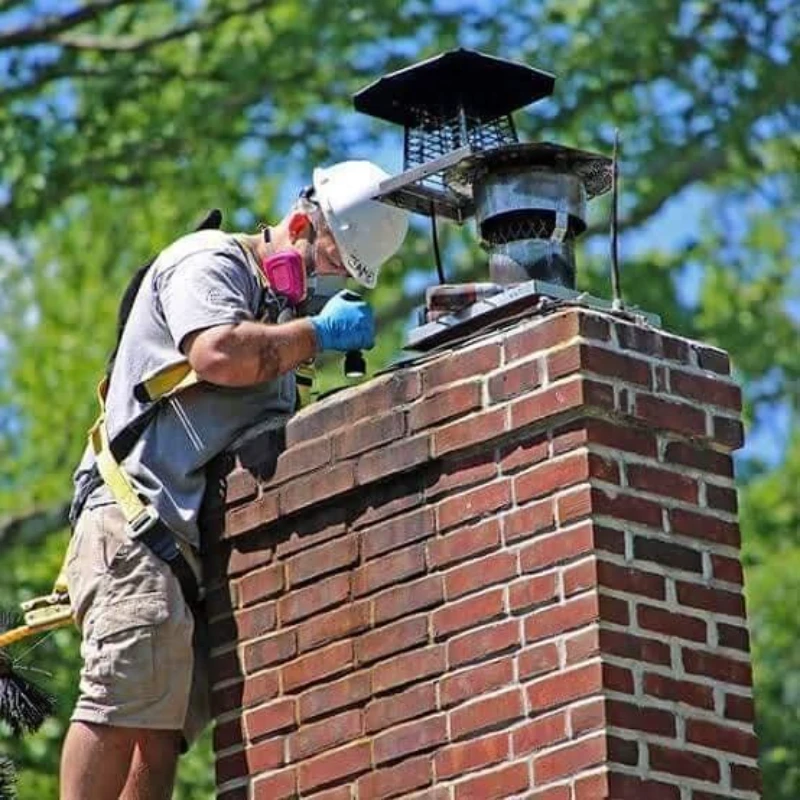
CSIA certified chimney service for Berea's 1950s–1980s homes. Many chimneys in this area were built with two flues — one for the fireplace, one for the old gas furnace. When the furnace was replaced decades ago, that second flue was left open inside the masonry. We inspect both.
Berea grew rapidly through the 1960s and 1970s as Greenville expanded northwest. Builders of that era routinely constructed chimneys with two separate clay tile flue columns inside a single masonry structure — one flue for the wood-burning fireplace, and one to vent the gas furnace that heated the home. This was standard practice and it worked well for the furnaces of the time. Then two things happened. High-efficiency condensing furnaces arrived in the 1990s and 2000s. These new units vent at low temperatures through PVC pipe directly through an exterior wall — no chimney needed. The old furnace was replaced, the PVC went through the wall, and the furnace flue inside the chimney was disconnected and left in place. Nobody capped it. Nobody inspected it. It has been sitting open ever since.
One chimney structure. Two separate clay tile flue columns running from the firebox to the roofline. Only one is in active use. The other has been abandoned — often for 20 to 30 years.
The two flue columns share the same outer masonry walls. Moisture and structural damage in the abandoned flue column directly affects the integrity of the masonry surrounding the active fireplace flue — they are not independent systems.
We confirm whether your chimney contains one flue or two. From outside, both flue columns are enclosed in the same masonry. We identify flue count at the roofline and confirm appliance connections from below before any work begins.
Standard masonry sweep: creosote removal, smoke shelf cleaning, firebox inspection, damper condition, clay tile liner assessment. Documented in writing with findings before any additional work is authorized.
We inspect the former furnace flue from the roofline cap (or open top) and from any accessible clean-out below. We document moisture staining, liner condition, and whether any cross-connection to the fireplace flue exists. Level 2 camera is recommended for abandoned flues where liner condition cannot be confirmed visually.
If the homeowner has experienced smoke back-puffing, poor draft, or cold air infiltration from the fireplace, we evaluate whether the abandoned flue is the source of cross-flue pressure before recommending any repair to the active flue.
We document condition findings for both flue columns independently. If abandoned flue capping or decommissioning is appropriate, we discuss options on-site. All pricing confirmed before any repair work begins.
Berea covers a broad area of northwest Greenville County with distinct housing eras and chimney profiles depending on the sub-area. We serve all addresses in the 29611 ZIP and adjacent northwest Greenville communities.
The oldest section of Berea, with homes dating from the 1940s through the 1960s built around the Berea community center and schools. This area has the highest concentration of dual-flue masonry chimneys where the furnace flue was abandoned when oil or gas heating was updated. Many original clay tile liners in this sub-area are 60–70 years old with no documented service history.
Development along US-25 from the late 1960s into the 1980s produced a range of ranch and split-level homes, many with builder-grade prefab fireplaces in addition to masonry chimneys. Both prefab and masonry systems are present in the same neighborhood. We confirm system type before applying the appropriate inspection protocol.
Transitional area between Berea proper and more rural Greenville County. Homes here range from 1950s farmhouse conversions with original wide-throat masonry chimneys to 1980s brick ranches. Wide-throat chimneys from the 1950s present unique draft challenges and are often oversized for current use — we account for throat dimensions when assessing draw and creosote accumulation patterns.
Where Berea transitions toward the Westcliffe and northwest downtown areas. Denser lot sizes, 1950s and early 1960s construction, many homes with single-flue masonry chimneys that served both a fireplace and a floor furnace through a shared flue — a configuration that requires careful assessment if a gas appliance is still present.
Every service we provide in central Greenville is available throughout Berea and the surrounding 29611 ZIP. CSIA and NFI certified technicians, same response standards.
Full creosote and debris removal from firebox, smoke shelf, and flue. Stage assessment with every sweep. Approximately $149–$229, confirmed on-site.
Service detailsLevel 1 with every sweep. Level 2 camera inspection required for dual-flue chimneys, abandoned flue assessment, and any chimney with no documented service history. Priced on-site.
Service detailsMortar joint repointing, chimney crown repair, brick replacement, damper repair or replacement. Common in Berea's 50–60 year old masonry chimneys. Priced on-site after inspection.
Service detailsStainless steel liner installation when original clay tile has cracked, spalled, or is undersized for current appliance. Liner sizing is confirmed by flue measurement and appliance BTU rating.
Service detailsVapor-permeable masonry sealant applied after inspection and repair. Berea's mature trees mean heavy moss and moisture loading on older chimney masonry — waterproofing slows future deterioration.
Service detailsDryer vent cleaning for all Berea homes. Long vent runs common in split-level and ranch floor plans accumulate lint more quickly. Approximately $99–$175, confirmed on-site.
Service detailsQuestions we hear regularly from Berea homeowners, particularly those dealing with dual-flue chimneys and draft issues.